The short answer is: carefully, and with less product than you think you need. The longer answer depends almost entirely on what finish is on your walls, because the same method that works fine on semi-gloss can visibly damage flat paint. Flat paint is what’s on the walls in most NYC apartments, which is exactly why this question comes up so often.
Start with the Finish
Semi-gloss and gloss have a hard, sealed surface. Water beads on them rather than soaking in, so a damp cloth with a small amount of dish soap cleans most marks. Eggshell and satin are a different story. The surface is more open, and the paint film is thinner, so it shows the effects of cleaning more readily. Circular scrubbing on either finish will burnish the paint — you end up with a shiny spot in the middle of a matte wall that no amount of re-cleaning will fix. Go in one direction, keep the pressure minimal, and stop as soon as the mark is gone.
Flat and matte finishes are different. They absorb moisture rather than shedding it, and they show exactly where they’ve been worked if you press too hard or use too much product. That doesn’t mean they can’t be cleaned—it means the approach must be considerably more restrained.
How to Clean Flat Paint Walls
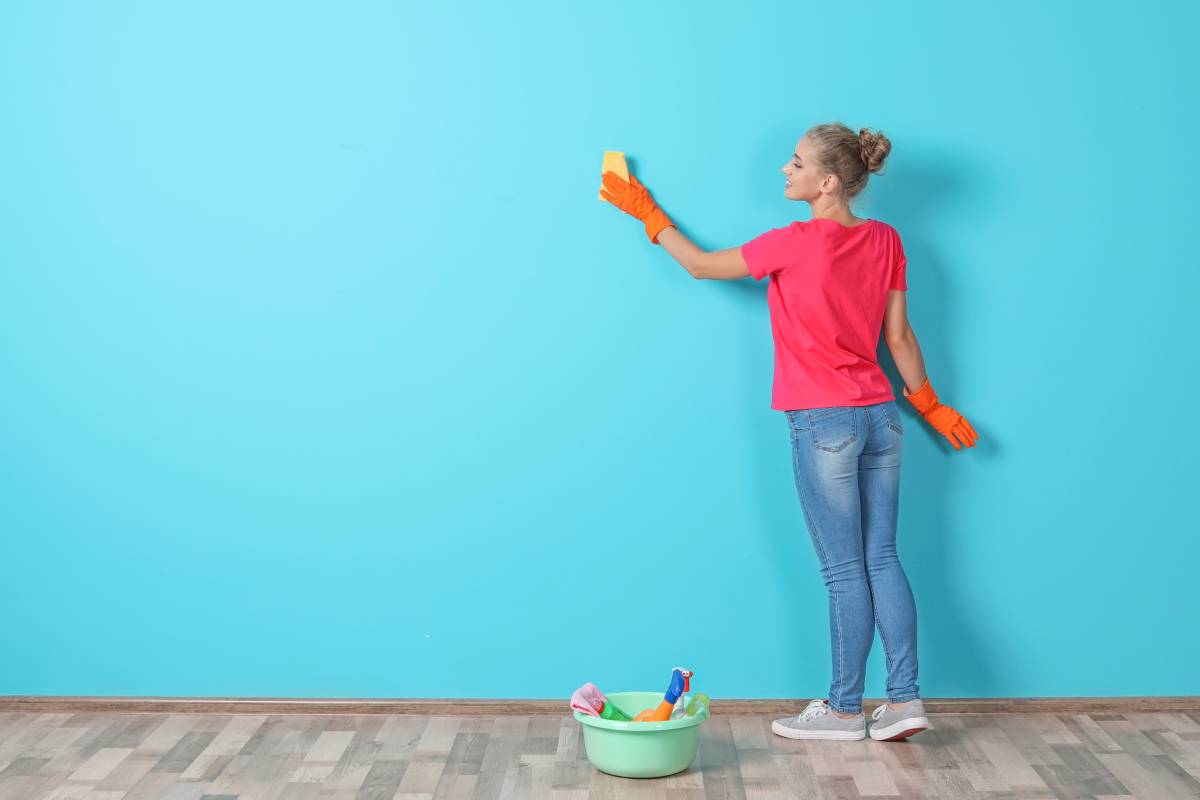
Flat paint is where most people cause more damage than they were trying to fix. The goal is minimal moisture, minimal friction, and as little product as possible—preferably none at all for lighter marks.
Start with a soft cloth or sponge wrung out until it’s barely damp, not dripping. Test an inconspicuous spot first. Wipe in one direction, gently, and stop before you think you should—it’s easy to keep going and end up with a dull patch. For a stubborn mark, a small amount of dish soap diluted heavily in water can help. The keyword is heavily. Rinse the area with a barely damp clean cloth and let it dry completely before deciding whether you need to go again.
Avoid all-purpose spray cleaners and melamine foam erasers entirely on flat paint. Cleaning sponges can be abrasive—they work by removing a thin layer of whatever surface they’re on, which is fine on semi-gloss but not on flat. The result is a permanent dull spot.
Cleaning Walls Without Removing Paint
A couple of practices apply regardless of finish. Start at the bottom of a mark and work upward. Cleaning downward pulls dirty water into the clean paint below it and leaves a streak that’s often harder to deal with than the original mark. Don’t let the wall air-dry after cleaning. Blot or wipe the area dry as you go — moisture sitting against paint film long enough will eventually cause it to soften or lift, even on semi-gloss.
For general upkeep in high-traffic areas—hallways, around light switches, near doors—a dry microfiber cloth handles most surface dust and light smudges without any product. Making that a regular habit is easier than dealing with the buildup later. And for anyone who finds themselves cleaning the same walls repeatedly: the lasting fix is usually the finish. Eggshell or satin in hallways and living areas is much easier to maintain than flat.
Get Help from Your Local NYC Benjamin Moore Paint Stores
If you’re at the point where the walls need more than cleaning—or you want to repaint in a finish that holds up better day to day—our team carries the full Benjamin Moore line. It can help you find a color and sheen that makes sense for how the room is lived in.
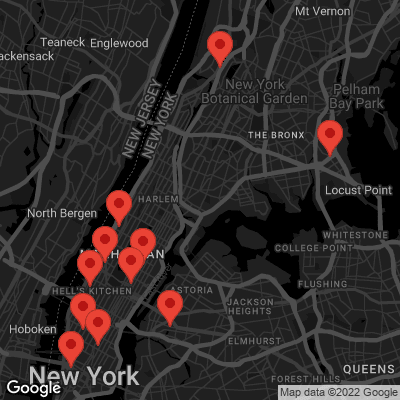
Book a Free Shop-At-Home Appointment to get started, or stop by one of our NYC showrooms. We’re locally owned and operated, always happy to serve our neighbors throughout Manhattan, SoHo, Chelsea, Long Island City, Gramercy Park, Hell’s Kitchen, Lower East Side, Throgs Neck, The Bronx, Upper East Side, Upper West Side, Uptown West, and Yorkville.